
A Brief Description
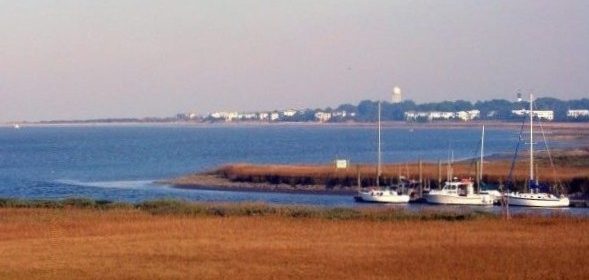
…Tybee Island is the most northerly of Georgia’s “Golden Isles.” Twenty miles east of Savannah, it has a small strip of land that extends westward, out into a vast area of coastal marshlands. This strip with its curling track toward the mainland and immediate access to the shipping channel, became the location for two consecutive quarantines that operated from the late 1700’s into the 1800’s. The first, established at the island’s western side on the tidal creek that now bears its name, was simply called a ‘lazaretto.’
The present-day Italian term “lazaretto, or lazaret” means hospital, but in the Middle Ages it literally meant “pest house” – a place of confinement for those dying from the plague or leprosy. Derived from the Hebrew word “lazar” or “leper,” it also refers to the biblical figure, “Lazarus,” the one whom Christ raised from the dead.
A Little History
… First, it’s important to understand that originally, the Charter of the State of Georgia contained a provision that prohibited the importation of slaves into the new colony. Georgia was to be home to a free (and sober) working class, much like the Yeomen’s class in England, where merchants and craftsmen combined with small farmers to make up the economies of small communities.
The founding philosophy was that slave ownership promoted laziness, and a privileged landed gentry. Many of the new Georgia transplants were indentured servants, whose debts had been forgiven back in England. These ‘reformed’ individuals were being given a second chance on the frontier of the Crown’s youngest colony. They were encouraged to value ‘thriftiness and hard work’ instead of excesses and indulgences. Thus, the Crown did not issue large land grants, as they had years before to the plantation owners of South Carolina. Instead, they appointed Trustees in Savannah as overseers of the common good.
Georgia’s first colonial settlers got forty acres to farm, and merchants and craftsmen were to set up shops in which to trade local goods and services. A portion of all proceeds and profits would go back to England through the Trustees. It sounded like a good plan, at first, but the colonists soon discovered that lowcountry coastal marshes were difficult to farm, and areas inland were often populated by native Americans who’d become less accommodating, and sometimes, downright hostile, not to mention the subtropical climate was infested with fever-bearing mosquitoes. (South Carolina planters had already come to terms with such obstacles and opted to import slave labor.)
Soon, neither the farmers nor the merchants could make ends meet. Settlers began leaving the new ‘buffer colony’ in droves. The noble experiment envisioned by Oglethorpe and the Trustees was fast becoming a miserable failure. In order to save the colony, the Crown began issuing large land grants to wealthier colonists, but the larger farms could not operate without a substantial, affordable labor force.
In 1749, increasing social, economic, and political pressure forced Georgia’s founding fathers to repeal the anti-slavery provisions in their Colonial Charter. When the act that permitted the importation of slaves was issued, it contained a provision to establish quarantines to combat the risks associated with the influx, as well as the usual threats caused by illnesses from incoming merchant ships. This reversal of social and commercial policy saved the colony’s economy, but opened up a world of woe for which the region would eventually pay dearly.
The quarantine at Lazaretto Creek, however, wasn’t built until 1768, almost twenty years later, on a hundred and four acres of land that had been purchased from Josiah Tattnall after locals requested its establishment. The buildings to house the sick were constructed on the western tip of the island across from South Channel Sound. The location served its purpose for less than two decades, but saw scores of ‘detainees’ due to the span of time in which it operated. During the days of the expanding slave trade, Tybee’s ‘lazaretto’ functioned continuously as a holding station. But in 1785, after continuous use throughout the American Revolution, the Grand Jury reported it in “ruinous condition” and completely uninhabitable. Consequently, it was abandoned, and a new site was opened across the way on nearby Cockspur Island
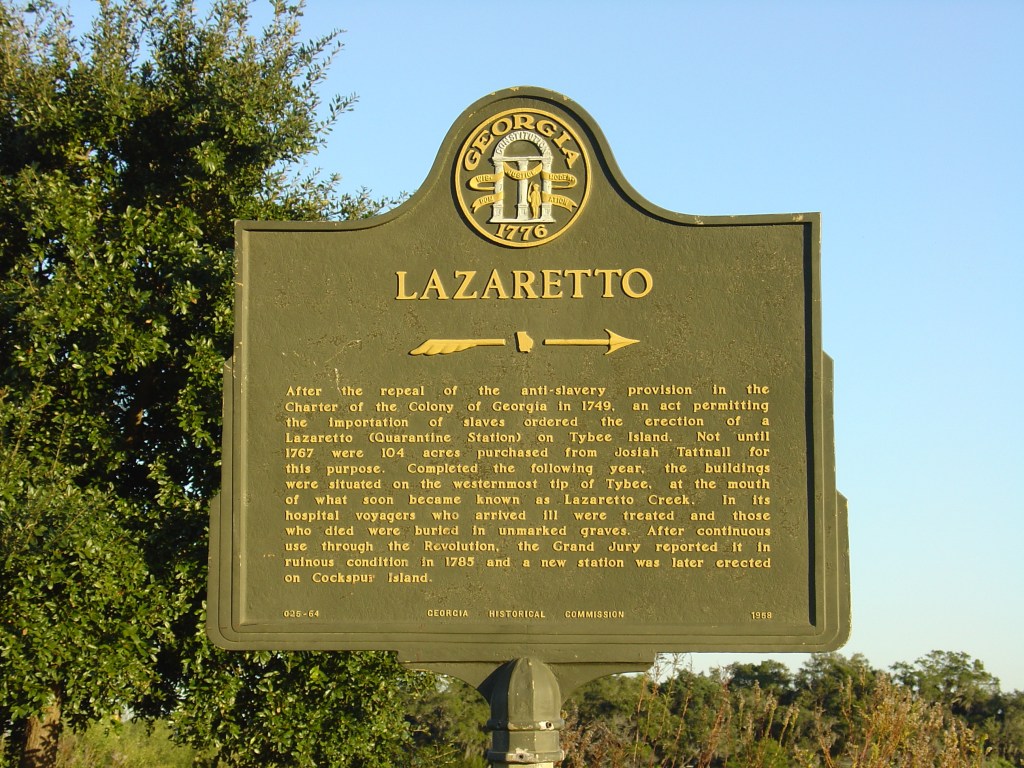
In 1958 the Georgia Historical Society erected an historic marker (pictured above) which still stands along Highway 80 East in the general vicinity of the original site near the bridge that now crosses the Lazaretto. A current effort is also underway to further memorialize the location of what is now considered a place of untold suffering and countless unmarked graves.
Notable Reflections
Like all eighteenth century seaports, Savannah could ill afford contamination of the mainland. In the days before public sanitation, immunizations and antibiotics, it was often necessary to employ drastic measures to keep imported infections from spreading. The rules were simple and applied to all incoming vessels. Any ship reporting an outbreak of cholera, yellow fever, smallpox, or malaria, had to unload the sick and cleanse the decks before continuing to port. Whether they traveled freely of their own accord, or emerged in chains from the cargo hold after surviving the treacherous middle passage, everyone was subject to the quarantine.
Accounts vary, as to how long a ship could be forced to remain at the mouth of the river – some say a month, others say, four, but with antsy crews and captains eager to get their goods to market, unfortunate souls who hadn’t fully recovered when the quarantine was lifted, were rowed ashore in small boats or tossed overboard to swim. Worse-case scenario, those who ended up at the ‘hospital’, became infected with something else, and ended up staying indefinitely. It wasn’t uncommon for creeping ‘killer’ diseases to lurk in such places, and research indicates that remote portions of Tybee’s first quarantine also served as a leper’s colony. No doubt, Lazaretto was a desolate place.
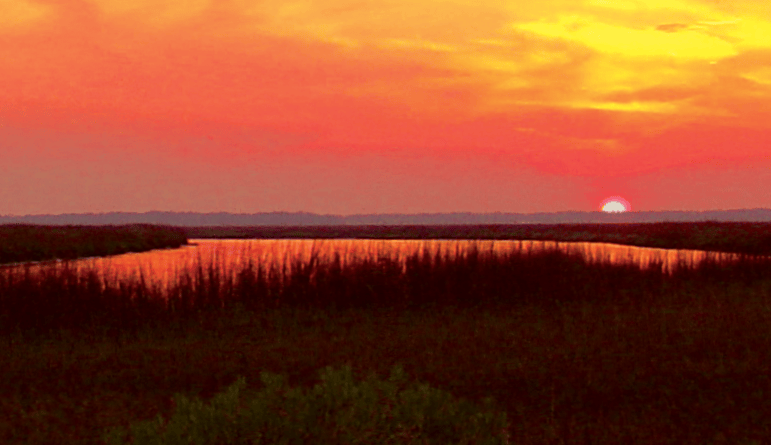
Today, these westernmost hammocks remain the picture of tranquility, and whatever secrets lie buried at the edge of the largest expanse of salt marsh on the entire southeastern coast are borne with a gentle serenity that time has yet to alter, – a silent testimony that speaks so loudly to the heart of the matter it all but quells the voice of the past. Selah.
Even so, were it possible for those who sleep here to weigh-in, I’ll bet they’d be the first to say the sunsets are magnificent!
Peace.
Thanks for reading!
Copyright 2025 – 2026 – Cynthia Farr Kinkel
(Portions of the above article that first appeared in the December 2005 issue of The Tybee Breeze Magazine under the byline of “Notes from a Tidewriter,” were revised, edited, and republished by The Tybee Times in 2010. The column, Ghosts on Tybee – Part One (Dec. 2005) & Part Two (Jan. 2006), was then revised and republished in its entirely at Real Spooks.com in 2012 to include Lazaretto’s Lost Souls – A Tybee Ghost Story; A Chill in the Basement and a History Lesson, as well as the poem, Song for Lazaretto.)
Photographs by Cynthia Farr Kinkel. All rights reserved.

