The Pond House: A Season of Rude Awakenings
Though I didn’t always appreciate it, one of the nicest things about attending college in the same small town where you grew up and your parents still lived was, whether as a matter of convenience or of necessity, you could usually go home. At least that’s what I thought at the beginning of Spring break in 1972, when I started spiking a fever and ended up in the hospital with severe abdominal pain. Consequently, I didn’t make it back to school or to Screven County, and my friends had to find another place to live.
This might be a good time to mention how in late August of 1971, four months before I moved out to Screven County, I’d joined a group of students on an “Art Studies in Europe” tour. Orchestrated by the department’s art history instructor, this two-week, whirlwind overview of cultural sites and museums for fine arts majors between quarters began with an afternoon at the Museum of Modern Art in New York City, and ended with a three-hour final exam that was taken on the flight home for which upon passage, we received full course credit.
The first seventy-two hours of the trip, my eyes never closed. After arriving in London, we visited the British Museum, the Tate Gallery, the National Gallery during the day, and at night my roommate and I met as many locals and discovered as much night life between Piccadilly Square and London Bridge as physically possible. By day four’s Sunday outing to Westminster and other cathedrals on the Salisbury Plain I was exhausted, in fact, once we finally got to Stonehenge, after wandering around a bit, I lay down on the biggest flat rock I could find and fell asleep. When our instructor discovered me and excused me to go to the bus, the long rear seat at the back seemed the best place to continue my nap.
As the lumbering bus drove the Amesbury Expressway back toward London, a small car carrying an elderly couple and two grandchildren crossed the line and we plowed into them, head-on. I awoke as my head hit a large metal ashtray. I dropped four feet onto the divider in the foot-well. The grandparents and one of the children, a small girl, died at the scene. A second child, a little boy, was taken in the same ambulance that transported me, the bus driver, and our art instructor to Salisbury Infirmary. I never knew what became of the bus driver or the boy, but our instructor, who’d been seated at the front of the bus, was treated for cuts caused by shattered glass and released the following day. I was admitted with a hairline-fracture, a mild concussion, and pain in my lower back and left side, but didn’t receive any pain medication due to the concussion. My only relief was sleep, and for the first two days, I slept so much the doctors feared the concussion was causing it, and kept me under close ‘observation.’ The other students, though badly shaken, had escaped injury, so the tour went on to Paris without me.
I was four days in the ward before I was up and walking around. But on day six, they determined me well enough for release, and with help from the British consulate and a Londoner friend I’d met at the Wimpy’s hamburger shop located across from our motel, I was able to fly to Paris and rejoin the tour for its duration. Fully rested and youthfully resilient, I made it through France, Germany, Italy, and the exam on the way home with little problem. I had paced myself, but I was far from over it.
We arrived home in the States as Fall Quarter was beginning, and life at school went on as anticipated until right before Christmas break when my parents announced they were ‘separating.’ As a young adult living across town, it came as no surprise. Just a big disappointment, and in some ways, a relief—they’d been heading in that direction since the Spring of 1968. But for my younger siblings—one, off at college in Athens, the other attending high school in North Georgia, this Christmas would be a double-dose of reality.
A staggered load of one-to-five-hour courses, during my Freshman and Sophomore years, had often required me to be at school all day and many times, at night. I was currently living five minutes away from campus in a trailer that my mother had talked my daddy into purchasing new in 1970. With three bedrooms and a bath and a half, it was cheaper with two rent-paying roommates than on-campus student housing or off-campus boarding elsewhere, but the situation was quickly escalating into “fruit basket turn over.” Come January, Mama would remain at the house in town, Daddy would move into the trailer, and my trailer mates had to go.
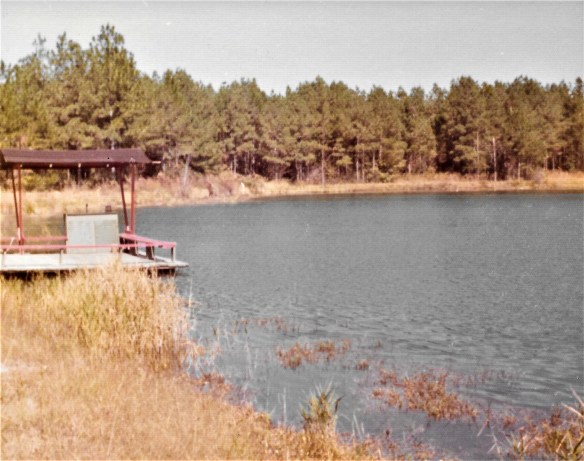
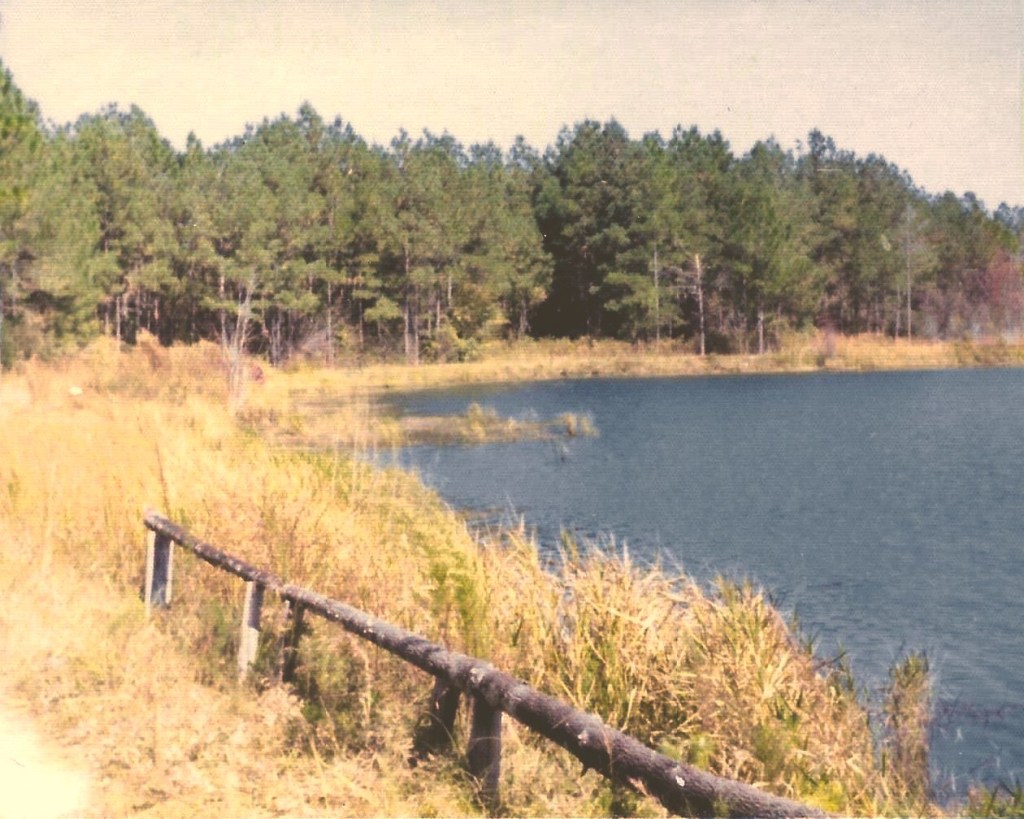
In truth, my desire to finish what I feared might be a useless college degree was waning. After securing living arrangements for the upcoming Winter quarter, my trailer mates packed up and left for the holidays, but when I suggested I might drop out for a while, get a job, and rent a place of my own, Daddy mentioned the pond house as a temporary solution. Bless his heart – he wasn’t about to let me quit school. While the pond house in Screven County seemed worlds away from campus, I dearly loved the place, and decided to take him up on the offer. As long I could keep my 1969 Ford Maverick running back and forth, I was up for it.
One of my dearest hometown friends, named Carolyn, came over to help me pack. Neither of us had money to spend on gifts that year. Three days before Christmas we collected milk cartons, bought food coloring, vanilla extract, cloves, cinnamon, and a large box of paraffin, and gathered all the plain white tapers we could find. After repurposing the wicks, we spent the evening in the kitchen at the trailer melting them down with the paraffin to make layered scented sand candles to give to each of the members of our families.
Christmas 1971 was on a Saturday. Our immediate family opened presents together at the house in town and ignored the elephant in the room. Everybody liked the candles. Later that morning, Mama, my sister, and I picked up Mama’s mother, “Grandma,” while Daddy and my brother picked up Daddy’s mother, “Gran,” and we all drove out to Screven County in separate cars. Both Gran and Granddaddy had lived with the aunties at the farmhouse at different times as had my daddy in his youth. By 1971, Great Aunt Lottie had been ten years gone, and only Granddaddy still lived there with Great Aunt Mary, the last of the five surviving sisters along with her seventy-two-year-old nephew, Eugene.
☼ ☼ ☼
As best I can remember, Cousin Eugene lived in the attic. A gentle soul who never married, reserved, and slight-of-build, he dressed as if he were always headed to town or to church. He didn’t talk much, and even after the aunties’ single downstairs bathroom was fitted with indoor plumbing and running water, he preferred to use the outhouse in the chicken yard. “That’s just his way,” Aunt Lottie would say. “Eugene keeps to himself.” It made good sense to me. Eugène was a walking enigma—not exactly a “Boo Radley,” just an unassuming eccentric, a smiling bee-charmer, content to share a slice of honeycomb with me at the farmhouse counter.
For many years, a deep well adjacent the kitchen had provided fresh water for washing and drinking, first by crank and bucket, then by a powered pump. As a child I remember thinking how even in summer, the handy faucet anchored above the porcelain sink yielded some of the coldest water I’d ever tasted. Enclosed by a window with folding panes, the well was perfect for storage, and over the years the shelves that lined its inner walls continued to keep food from spoiling when space in the electric refrigerator was limited. The well’s outer structure still braced the back steps leading up to the kitchen door.
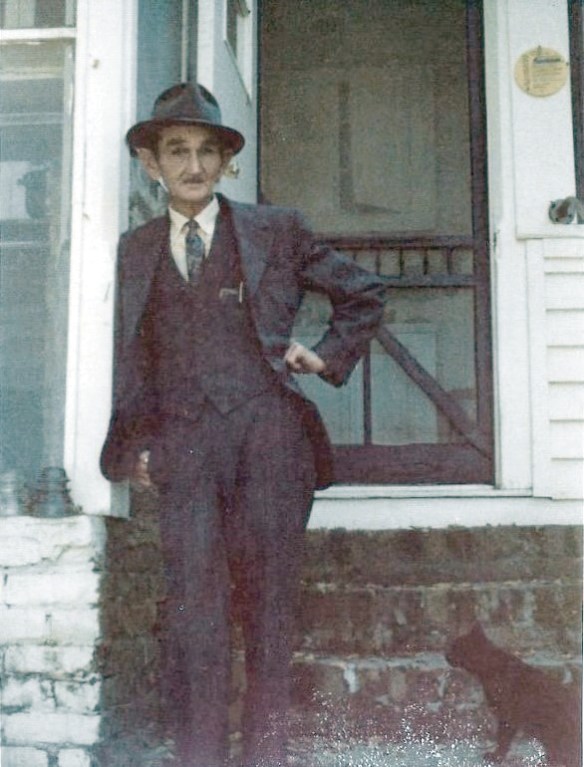
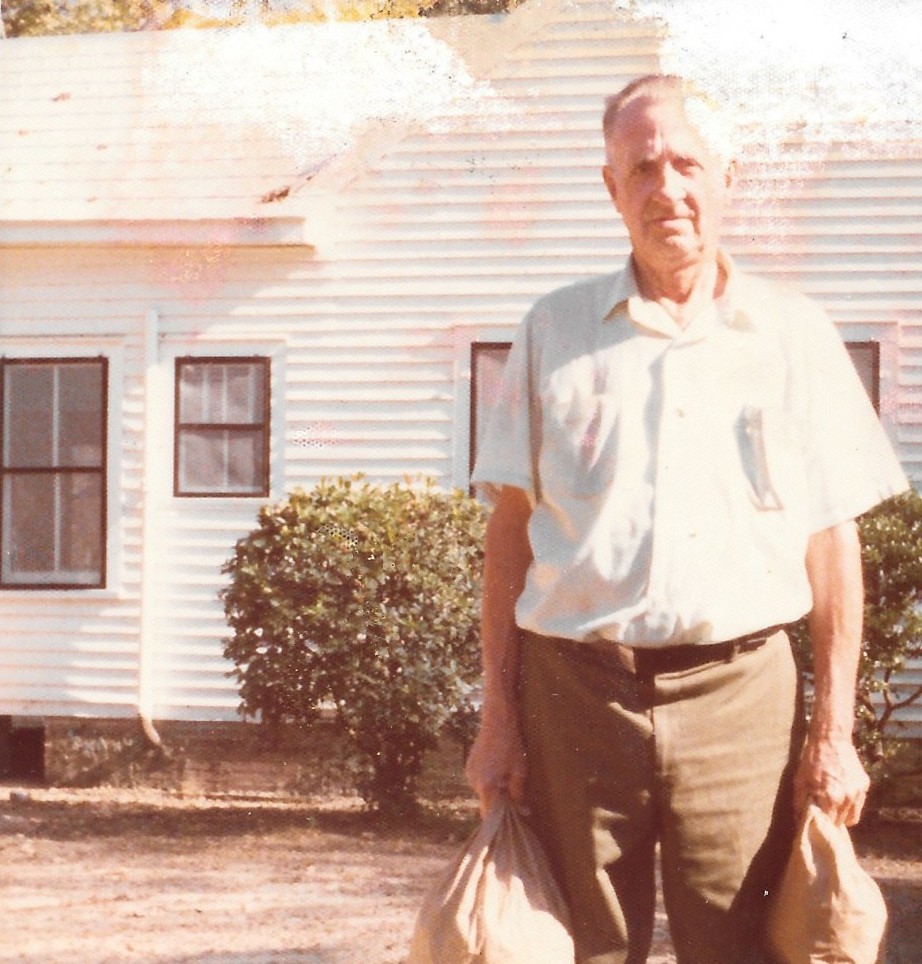
The last time I saw Cousin Eugene was in October of 1974, three months after Aunt Mary died. He was standing on those back steps looking much the way he’d always looked. He let me snap the above photo. As usual, most of the family had gathered at the farm house in December 1973 for Christmas dinner, but I’d moved to Atlanta in January and was in Western New York State when news came of Aunt Mary’s death a few days into July. When I arrived back home that October, Daddy said her property was on the market, so I rode out to Screven County with my camera, and stopped in at the farm house on my way to the pond.
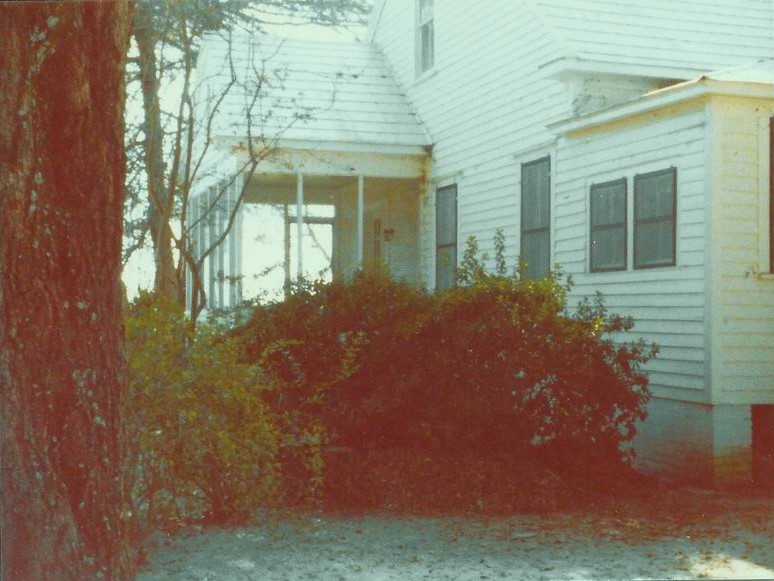


It was beyond strange, being there without Aunt Mary. The last time I saw her was on an evening in January before I left for Atlanta. Oddly enough, as I slowed to make the right turn into the field, I spotted her standing in the driveway of her house near the cattle grate, just a ‘hollerin’. When I stopped the car, and walked over to investigate, she told me she was worried about Granddaddy. He didn’t show up for supper, and it was getting late. I walked her to the house, hugged her, said I’d go looking for him and went back to the car. Just past the middle of the field, the Maverick’s headlights fell upon a figure crawling around on all fours. I slammed on the brakes, and put the car in park. Good Lord. It was Granddaddy, and had I not been paying attention, I might’ve run him over. Startled, he stiffened, and squinting with blurry-eyes, laughed in my direction. “I lost my darn glasses,” he cried, reaching around to pat the grass. “They’re somewhere … here.”
Jumping out to join the search, I found them in a rut nearby, but as I helped him into the car and began backing out toward the highway, he protested. “Where you going?” And when I replied, “To take you home,” he shook his head, and eyed me. Suspecting where I was headed, he insisted upon coming with me. Obviously, he was lonesome and had a lot on his mind. I called Aunt Mary from the pond to tell her he was okay, made us a strong pot of coffee, and before dropping him up at her house that night on my way back into town, had one of the most memorable visits ever with this wandering ‘enigma’ that was my grandfather. But he had taken to spending his nights up at Aunt Mary’s instead of sleeping in his car (which he’d apparently left in the woods that evening). Evidently, the land didn’t feel as welcoming to him as once it had, … nor did it to me.
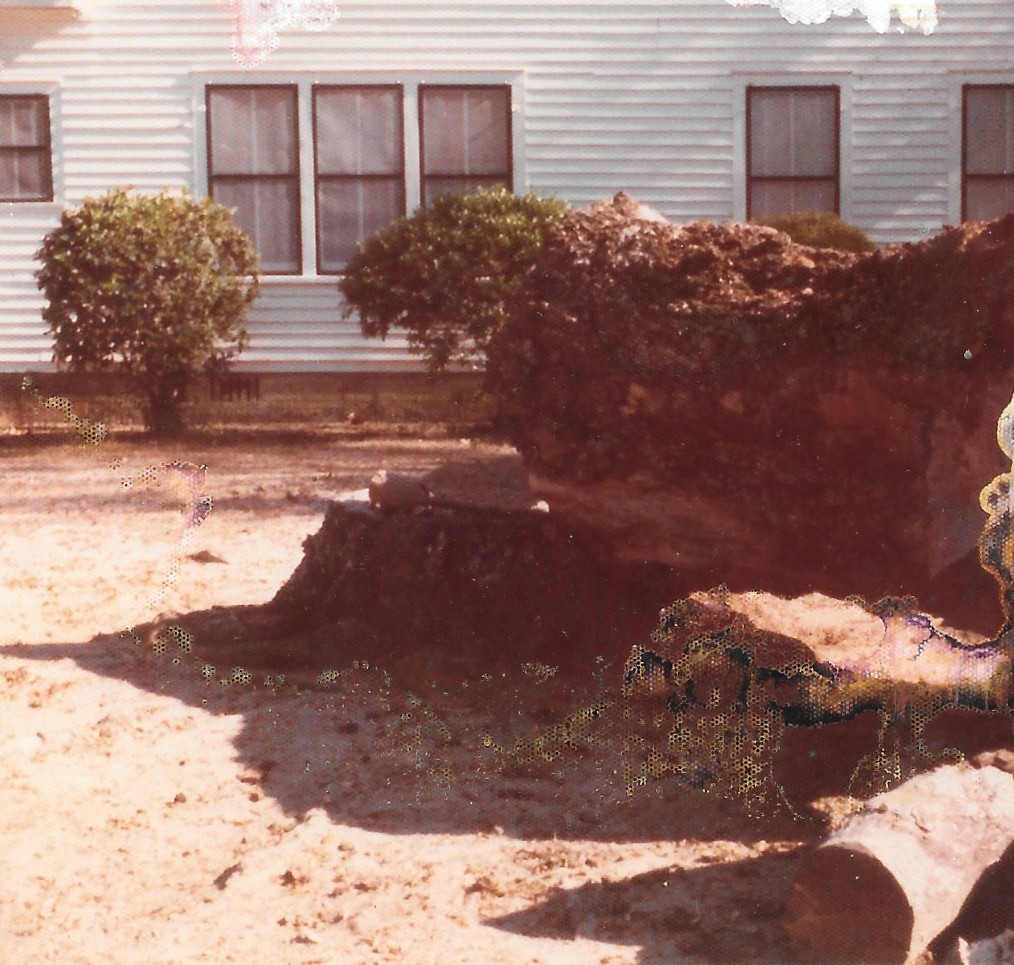
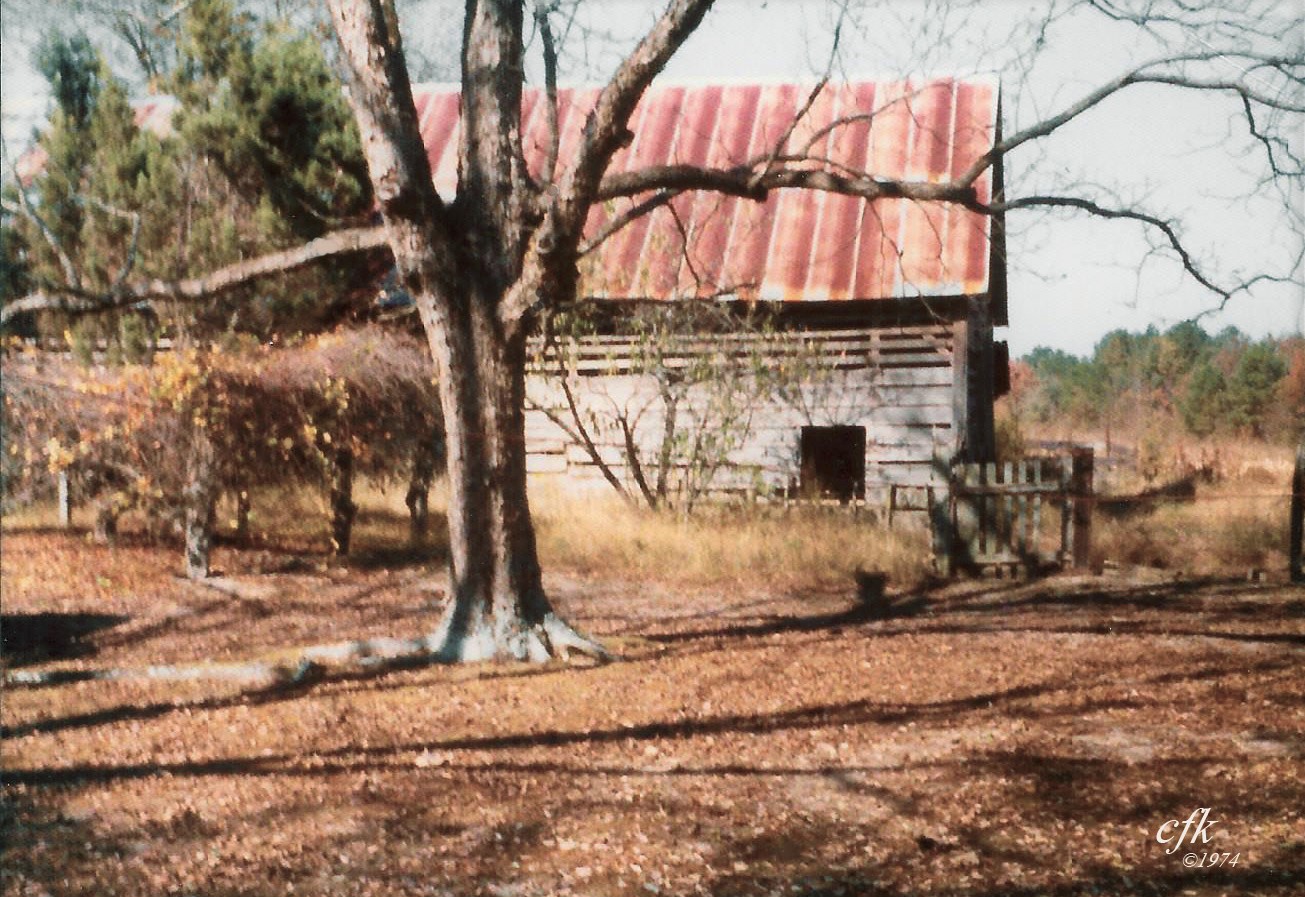
Nine months later, the old homestead was quiet. Though both Granddaddy and Eugene were there, in the stillness of fallen oak and pecan leaves, an eerie solemnity had settled over the place—as if it were frozen in time, but about to change forever. The house, the barn, the chicken yard, and the scuppernong vines all looked the same. The tilted pecan tree I used to climb still stretched to the smoke house. The only thing missing was the huge live oak that had shaded the west side of the house. Granddaddy said it had recently been struck by lightning and had to be taken down. He’d been picking up pecans in the orchard next door, but he showed me the stump, posed for a photo, and offered to ride over to the pond with me—“like old times,” he said. It was plain that the end of an era had come.
☼ ☼ ☼
But on Christmas Day in 1971, despite the gloom of my parents’ pending separation, the farmhouse was as merry and bright as ever. Aunt Mary’s old kitchen now sported an electric oven, but its original, vented wood stove continued to function as a backup. Consequently, you pretty much knew what was cooking as soon as you pulled into the driveway. Cousins from Jesup had already arrived. Others from Dover and Cooperville would be stopping in to exchange season’s greetings. Some would stay for dinner. Except for Sundays, holidays, and special occasions, the formal rooms of the house were normally closed off during the winter, but now they were open with oil furnaces burning. A cedar wreath with red holly berries graced the entryway and mistletoe hung in the central hall, but there were never any electric lights on the tree in the living room. Usually a cedar, sometimes a holly, it was decorated only with handmade ornaments and silver strands of garland.
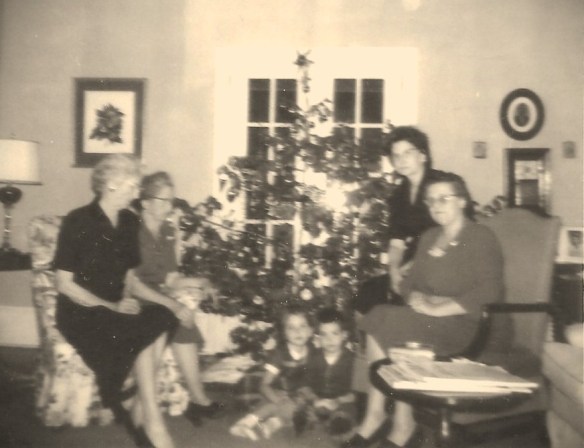
The long hardwood dining-room table was always dressed in white linen, its candled centerpiece sported crimson camellia japonica blossoms and green magnolia leaves with a watered-down buttermilk shine. A sideboard cornucopia of traditional southern fare included a roasted turkey stuffed with cornbread dressing, country ham from the smokehouse, red-eye gravy, mashed Irish potatoes, sweet potato soufflé, steamed yellow squash, baked macaroni casserole, butterbeans, fried okra, field peas, hot biscuits, fresh-churned butter, scuppernong jelly, and bee-tree honey. After the main course, there were side-porch delights such as pecan, coconut custard, and lemon meringue pies, banana pudding, chocolate or traditional pound-cake, and fresh-fruit ambrosia. After the table was cleared and the leftovers covered, the furnaces were lowered, the rooms in the front of the house and the hallway were closed off, and the dishes were washed in the residual warmth of the kitchen. While the spryer men went hunting, the rest of the family retired to the sitting room at the back of the house to talk, watch TV, play Chinese checkers, or nap by the fire. By the way, though the farm folks liked my candles, I don’t think they ever lit them. Granddaddy said they smelled too good to burn.
I spent the next few days in town and at the trailer, packing, and on the evening of December thirtieth, my friend Carolyn accompanied me out to Screven County. It was twilight and chilly as we hauled my belongings across the threshold. We didn’t stick around—New Year’s weekend found us partying with friends. I took the last load of boxes from the trailer out on January third. The day before Winter quarter registration, I ran into a couple who happened to be looking for off-campus housing. When I asked Daddy about roommates, he agreed it was a good idea since we’d be twelve miles out in the woods… Not long after, I was given a three-month-old Labrador-shepherd puppy who soon grew into a super watchdog as smart as he was friendly. Of course, Daddy and Granddaddy were always dropping by to check on us—Daddy had left his loaded rifle over the fireplace and made sure plenty of extra shells were handy. As the quarter progressed, we thoroughly enjoyed the experience. We all had ended up with afternoon and evening classes, making the time and distance more manageable, (even with late nights by the fire). The thought that we may have encountered ‘supernatural oddities’ only added to the fun, in fact, everything was going pretty well, until some of the masked injuries I’d apparently sustained during the bus accident in the U.K. suddenly began to surface—a flock of significantly debilitating symptoms sent me to the Emergency Room during Spring Break.
Initially, I was diagnosed with a case of severe ulcerative colitis, prescribed antibiotics, put on a restricted diet, and ordered to bed. Everyone insisted that I stay in town with Mama. So much for continuing school or living in Screven County. For three months, I remained with Mama, and was in and out of the doctor’s office. Still hoping to be well enough to attend summer-school to make up for lost time, I resigned to recuperate at home, … but even that was about to change.
Toward the end of April, my parents decided they needed to sell the house in town and wanted to be out of it by the Fourth of July. The new plan was for my sister, Carole, to continue in Athens that summer, Daddy would live at the trailer with my younger brother, Frank, soon to be home from school, and Mama would move out to the pond house. I was welcome there, too, but all I wanted was to be in town and get well enough to get back to school in June…a notion I had to abandon after nearly relapsing toward the end of May. Again, school would have to wait, but by the time my parents’ house went on the market in July, my grandmother had offered me her sofa bed until I could make other arrangements. With school out of the question, I thought maybe I could at least manage a part-time job, so the second week of July, I applied to be a server at the local Holiday Inn restaurant just a block away from Gran’s apartment. A week later, I collapsed in the kitchen – all of the symptoms were back with a vengeance, accompanied by fever, cramps, nausea, muscle weakness, and a strange tingling and ‘pulling’ sensation in my right arm and leg. This time the doctors didn’t mention colitis. They said evidently, a large uterine cyst had ruptured and caused a serious low-grade infection. That didn’t explain the nerve-related issues, nor did they seek to address them. I left the hospital with more antibiotics and went back to Gran’s sofa bed.
I was feeling really awful, when another college friend named Susan, a fellow music-major, recently graduated, came back to town and stopped in for a visit. She took one look at me and said she was packing my bag and taking me home with her, to see –of all people—her chiropractor, whose office happened to be next door to the apartment she was renting fifty miles away in Vidalia, Georgia. I’d seen a local practitioner in the past for headaches and shoulder stiffness, but her “doctor of chiropractic,” a nutrition-centric graduate of Palmer College, turned out to be a miracle-worker.
A thorough review of my x-rays was shocking! Even the images of my upper spine were nothing like what I recalled from the x-rays taken by my local practitioner three years earlier. The new images revealed that from the atlas and axis vertebrae, down, through the lower lumbar regions of my spine, the alignment had been dramatically altered – crimped toward the top, bent in the middle, and generally and overall, shifted to the right. When I mentioned the bus accident and how I was thrown forward and dropped onto the floor-well, my friend’s doctor said I was blessed to still be walking.
At first, I had two adjustments a day. On day four, it was one. The following week, the worst symptoms had disappeared, and I was completely out of pain. I kept up with the exercises prescribed to strengthen the spinal corrections, and by the middle of August, my spine was straight, I was maintaining a healthy diet that included a supplement for GI support, and the debilitating symptoms were gone, in fact, they never returned. My friend, Carolyn, also ended up going to, and was greatly helped by, this same chiropractor. For the sake of convenience, we both stayed at Susan’s apartment, and toward the end of August Carolyn had applied for a job in Atlanta, and I was able to rent an upstairs room in an old boarding house back in town. By September, I had resumed a full schedule of classes for my final year of school, and though I still carried some emotional baggage, my health had been restored.
☼ ☼ ☼
PS: For the record, Mama didn’t live at the pond house long. She found an apartment in town that put her closer to work. After she left, Daddy and Bill Williams added the screened porch onto the house, and Daddy had the trailer moved the from the park in town to a spot near the house at the pond. My sister, my brother, and I spent Christmas Eve in the trailer, wrapping presents and playing albums while Daddy and Gran prepared food in the kitchen next door for tomorrow’s gathering up at the farm house. That night, I slept in my old bedroom at the front of the trailer, while my sister slept in the rear. We awoke to find all of the furniture in the living area had been strangely and quietly ‘rearranged’ – almost like somebody had ‘pranked’ us – maybe, Santa. Frank had retired to the house with Daddy and Gran, leaving the door unlocked – it was just the five of us out there, nobody else, so there was no reason to lock it. How such a thing happened or why was beyond puzzling, given that nobody ever admitted to doing it. The Christmas get-together up at the farm house on the highway was another traditional feast with Aunt Mary, Granddaddy, Eugene, and the regulars from Cooperville, minus Mama and her side of the family. I spent New Year’s Eve with locals at a homestead on the outskirts of town playing acoustic music. My friend Carolyn, back for the holidays, was also there.
From January on, I concentrated on finishing my degree – I had accumulated enough college credits to graduate in music, but I chose to go with studio arts. My friend, Susan, had graduated in music education and was now a choral teacher, but teaching had never appealed to me, and there didn’t seem much for a theory major to do but to perform or write. During those long winter evenings I stuck around campus, and when I wasn’t working with acrylics or oils or water colors on the third floor of the Foy Fine Arts Building, I stole downstairs to one of the music department practice rooms to play piano. Some weekends, I simply drove to Atlanta, which is where I might have been by Friday, February 9th, had not my Maverick slid down an icy embankment into a ditch the night before. It was the week of the Great Southeastern Snowstorm of 1973. Classes had been cancelled, and I’d just left the Foy Building where there was enough snow on the forth-floor ‘walk-out’ roof that frolicking students were making snowballs and tossing them down at passers-by below. Snow was a rarity, and I should have known better than to drive to the homestead on the outskirts of town much less to wait to leave until it was almost dark. After a long trudge back through snow and slush to make a phone call, I ended up spending the weekend there. waiting for the wrecker to show. “Good thing, you weren’t stuck in Atlanta,” everybody said…..
By graduation that summer, I was as anxious to “get out of Dodge” as any of my friends had ever been. At that point, Dark Side of the Moon wasn’t just another Pink Floyd album. Time was slipping away, and I was “twenty-four and so much more.”
My brother, Frank, stayed at the pond with Daddy that summer. He lived with his friend, J.D. in the trailer. A skilled drummer, he would eventually move to Atlanta and play with the group, Flossy May, founded by Jim “Bird” Youmans of Kudzu fame (with whom my friend Randy McDonald had played on the weekends during our senior year in high school) before Bird’s brief but extraordinary foray with Frank Zappa. My brother would go on to make his own mark as drummer in a legendary Southeastern touring band known as Snow, and later, in the Ben Friedman Band.
I gave up my lease at the boarding house that fall and went on the road with a musician who initially was playing flute and saxophone in an Atlanta-based band called Stagecoach, and left for a high-paying, whirlwind gig with Wayne Cochran’s CC Riders. For me, it was more like Waitin’ on a bus – Jesus Done Left Chicago, and in January of 1974, I was off chasing rainbows of my own looking for a job at the High Museum. I was a musician, but my degree was in art. Go figure.
I never called the pond house “home,” again, but it certainly remained in my psyche. Experiences there had sparked questions, some which remain unanswered to this day,… including one particular night of high strangeness following an endearing afternoon the second weekend in June, 1972, a month before my parents sold their house in town…
☼ ☼ ☼
© 2024-2026
Copyright ©2024 – 2026 Cynthia Farr Kinkel. All Rights Reserved.
 Cynthia Farr Kinkel